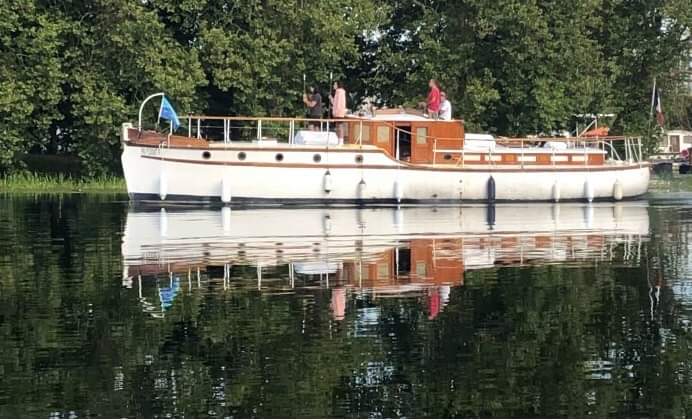
DAVIA
The Davia moored at sunset on the river Yonne, golden light on the varnished hull

1929 — 2029

A century of sea, war and resurrection

Built at Rosneath in 1929, requisitioned at Dunkirk in 1940, saved at Limay in 1992, taken on again at Villeneuve-sur-Yonne in 2014. The full story of the last Dunkirk Little Ship over 50 ft (15 m) in France.

Scottish beginnings

1929

Built at Rosneath by James Silver Limited

In the spring of 1929, on the shores of the Gareloch in Scotland, the James Silver Limited yard at Rosneath assembled a 52 ft (15.85 m) motor yacht designed by the naval architect John Bain. The boat belonged to the Brown Owl class, a line of elegant motor yachts known for the quality of their build and their seaworthiness.

The hull combined three fine woods: English oak for the frames and keel, iroko for the planking, Maine pine for the fit-out. The deck was teak, as British tradition demanded. On board: a bronze bell engraved Davia 1929, a prism deck light set into the deck to bring daylight into the saloon, and a flag locker for the international code of maritime signals.

Her first owner was Sir William "Alec" Coryton, future Air Chief Marshal of the Royal Air Force, Knight Commander of the Order of the Bath, Chevalier of the Légion d'Honneur, Commander of the Legion of Merit. From her very first year, the Davia stood out: in 1930, under Coryton's command, she won the André Gold Cup for the best performance in the London-Cowes race.
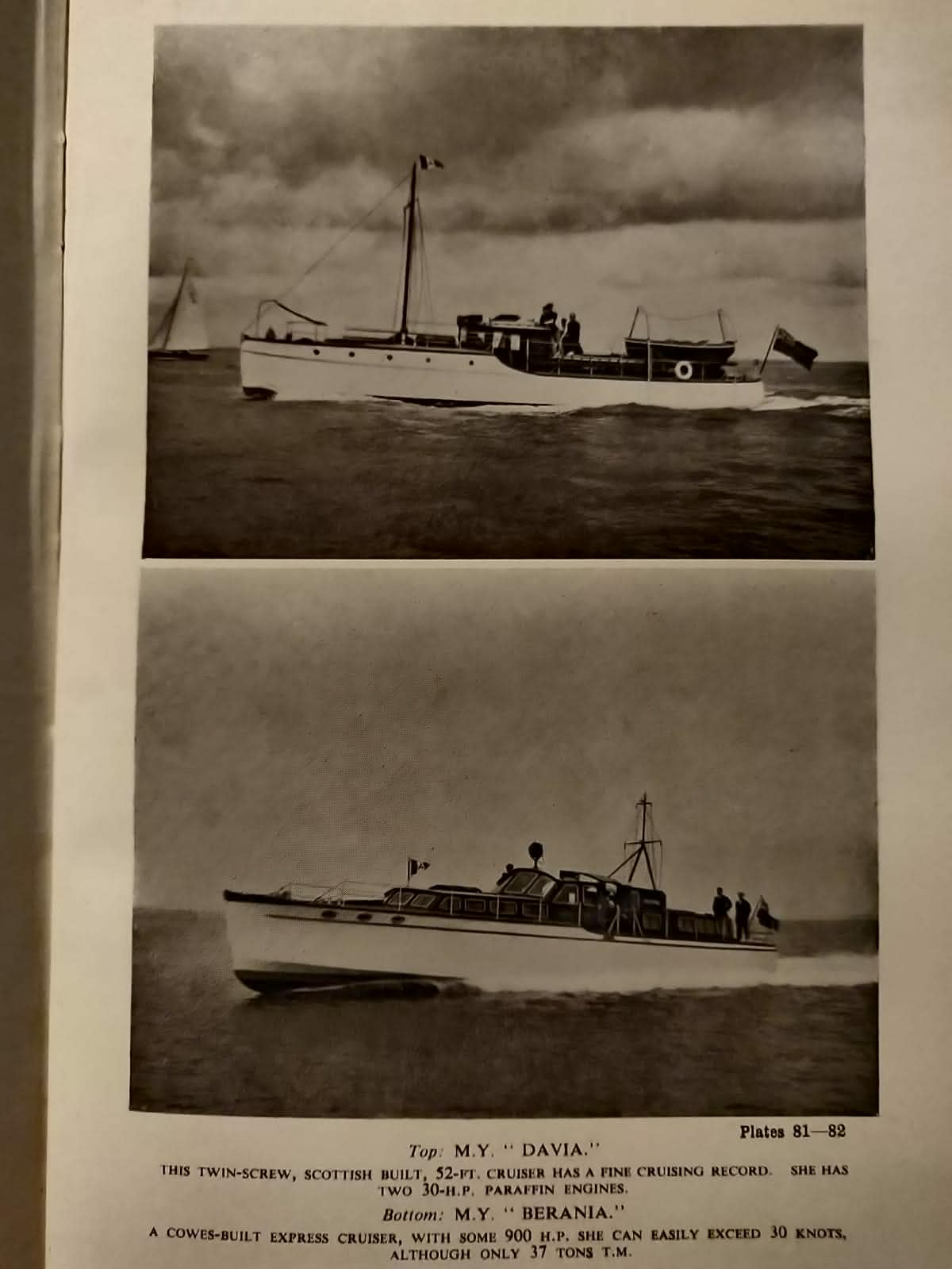
Page from the 1929 Motor Cruising magazine mentioning the M.Y. Davia
Page from Motor Cruising magazine, 1929 — the first public mention of the Davia

Operation Dynamo

May 1940

The Davia joins the 848 Little Ships

On 26 May 1940, British Admiral Bertram Ramsay launched from Dover an evacuation operation without precedent: Operation Dynamo. Caught in a pincer at Dunkirk by German armoured divisions twice their number, more than 400,000 Allied soldiers were trapped on the beaches, with no shelter and no hope of retreat by land.

The Royal Navy's warships were too large to reach the beaches. Sir Winston Churchill, the Prime Minister, made an appeal: everything that could float had to be gathered. 848 civilian boats answered the call — pleasure yachts, fishing trawlers, river launches, lifeboats, Thames tugs. The Davia was one of them.

In nine days, from 27 May to 4 June 1940, these Little Ships evacuated 338,226 Allied soldiers: 198,229 British and 139,997 French. This came to be known as the Miracle of Dunkirk, and gave rise to the phrase Dunkirk Spirit. In 1942 the Davia was taken on as an auxiliary vessel of the Royal Navy at Greenhithe, on the Thames.

On 4 June 1940, before the House of Commons, Churchill delivered the speech that went down in history: "We shall fight on the beaches, we shall fight on the landing grounds, we shall fight in the fields and in the streets, we shall fight in the hills. We shall never surrender."

Read: what is a Dunkirk Little Ship?

Watch the French Navy report #Dynamo85

Report by Vladimir Berquez, official page of the French Navy

Pennant of the Association of Dunkirk Little Ships
The ADLS pennant, flown by the surviving boats of Operation Dynamo

« In May 1940, at Dunkirk, my grandfather spent two days in the water before he was rescued. He told me the incredible story of Operation Dynamo. »

Bruno Van Hemelryck

President of the association

Many lives

1942 — 1992

From the Thames to the wreck at Limay

After the war, the Davia changed hands several times and was renamed twice. In 1954 she became Barracuda. In 1969 she became Barracuda II, and her two original Parsons engines were replaced by Parsons Engineering Co. units of 56.77 horsepower each, which are still in service today.

In 1974, the American John Shelby, an administrator of the International Herald Tribune in Paris, brought her back to France to run river tourism on the canals of Burgundy. The boat left British waters for good.

In 1980, sold once more, she was gradually abandoned. She was found as a wreck in the harbour of Limay (Yvelines) in the early 1990s. It was there, in 1992, that Jacqueline and Francis Ruffenach rescued her. An anecdote told by Jacqueline recounts the convoy's flight up the Seine, intercepted by the Paris river brigade: "If I stop, I'll sink right in front of the Trocadéro!", Francis called out from the deck. The Davia reached Migennes for five years of work at the Evans boatyard.

The encounter

October 2014

Bruno discovers the Davia under a tarpaulin at Villeneuve-sur-Yonne

October 2014. Bruno Van Hemelryck was looking for a houseboat. A former pupil of the Prytanée Militaire de la Flèche, the son of a retired French Navy officer and the grandson of a Dunkirk survivor, he has the sea in his blood. At the harbour of Villeneuve-sur-Yonne, he slipped under a work tarpaulin and discovered a sleeping yacht. Francis Ruffenach told him the full story: Scotland, Coryton, Dunkirk.

Bruno fell under her spell. He bought the Davia and took up the restoration where the Ruffenachs had left off. It was the start of a ten-year adventure that still continues.

Read the full story of the discovery

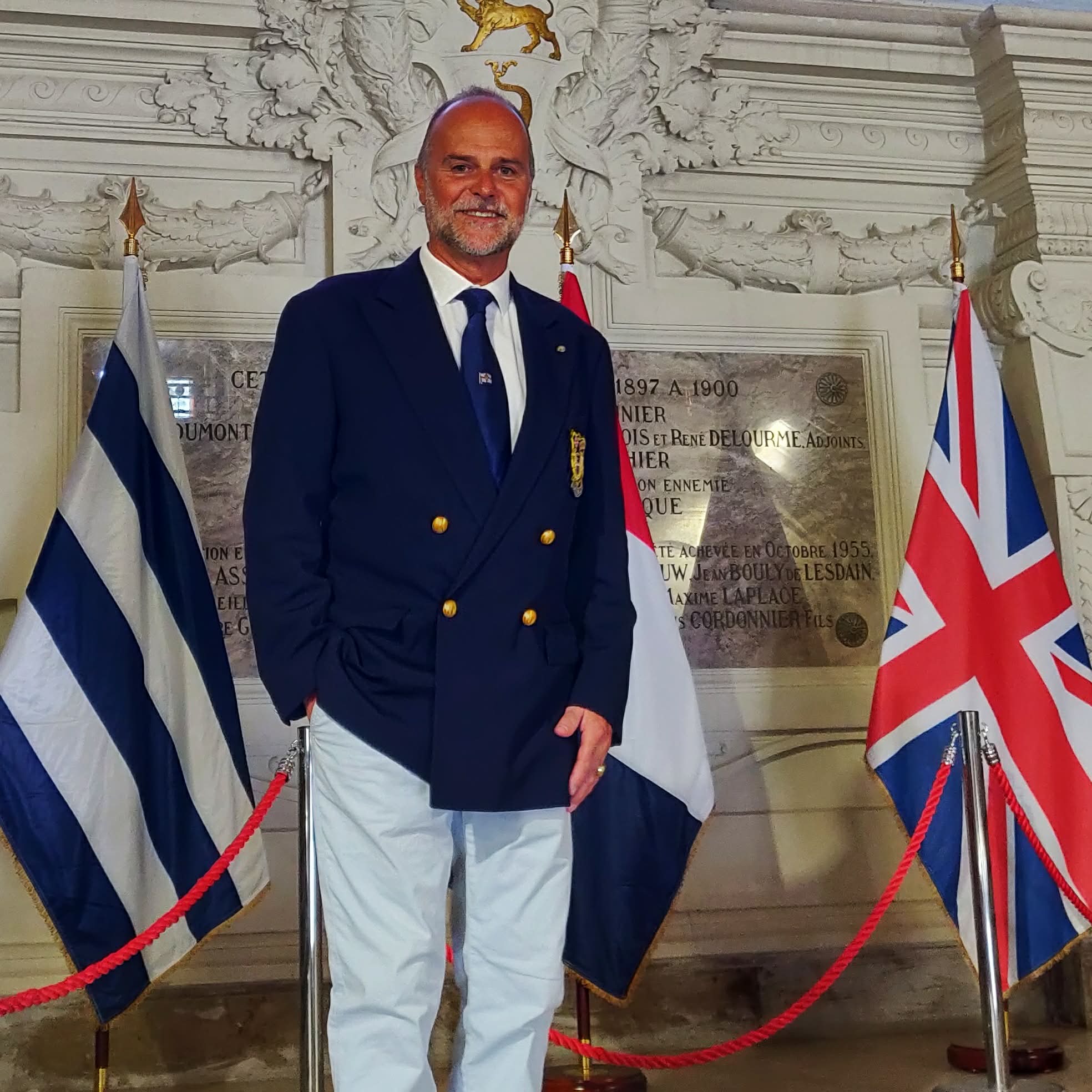
Bruno Van Hemelryck, president of the Davia Association
Bruno Van Hemelryck, former pupil of the Prytanée Militaire de la Flèche, son of a French Navy officer

« The boat was ready to become beautiful again. She was like the chrysalis of a future butterfly. »

Bruno Van Hemelryck

On discovering the Davia in 2014

Member of the Dunkirk Little Ships

September 2016

Official recognition by the British ADLS

In 2016, Bruno began the process of having the Davia officially recognised as a Dunkirk Little Ship. After exchanges with the archivist John Tough and verification of the Royal Navy records, the Association of Dunkirk Little Ships (ADLS) confirmed the boat's historic status.

In September 2016, the Davia became a full member of the ADLS, a British organisation founded in 1965 and placed since 1990 under the honorary presidency of H.R.H. Prince Michael of Kent. The boat was entered on the register of Dunkirk Little Ships under the name Davia 1929. It was also on this occasion that she was listed with National Historic Ships UK under number 3670.

Read: how the Davia joined the ADLS

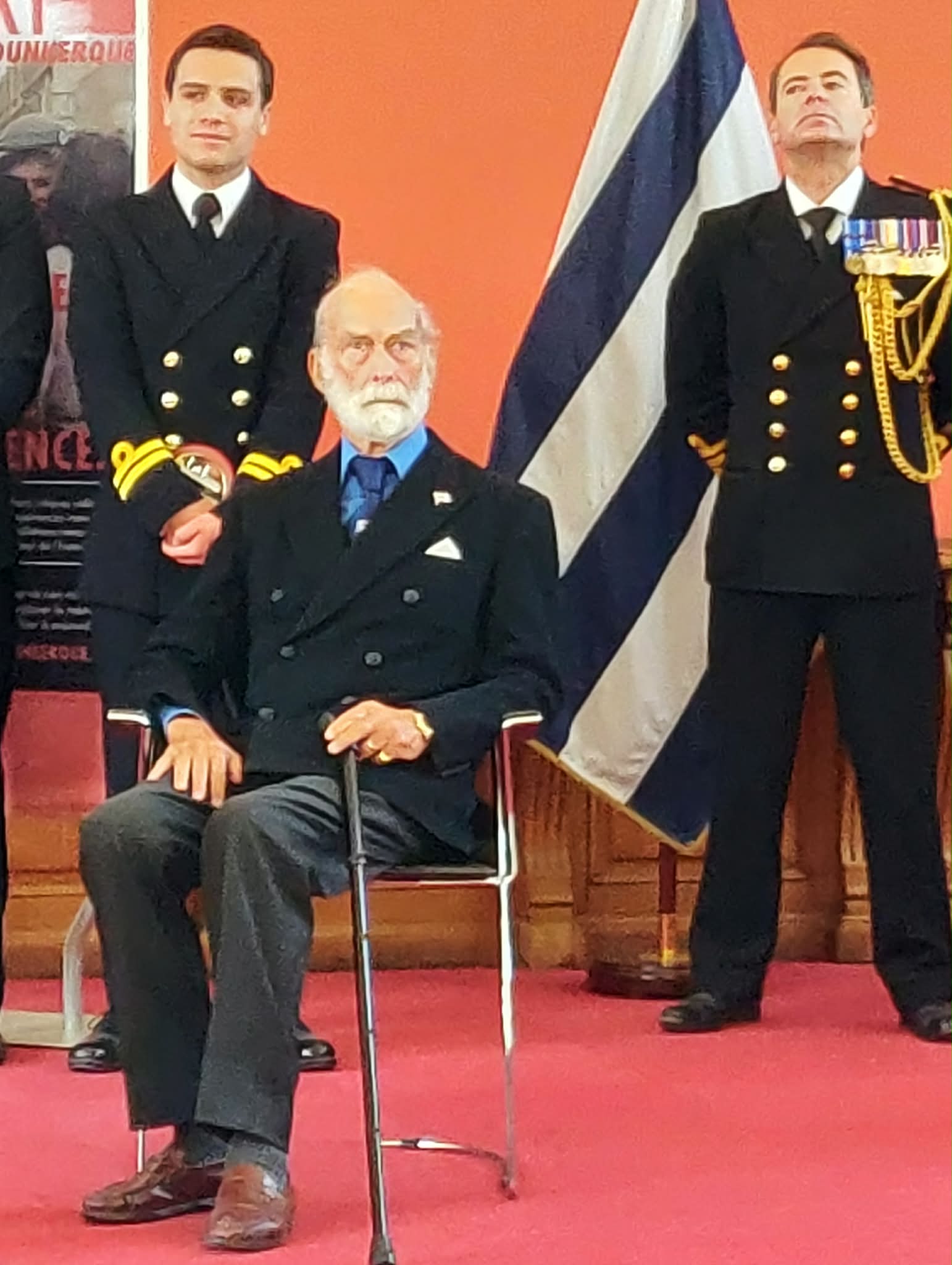
Prince Michael of Kent, president of honour of the ADLS, at a ceremony
H.R.H. Prince Michael of Kent, Honorary Admiral of the Association of Dunkirk Little Ships

Vessel of Heritage Interest

October 2019

French label awarded by Patrimoine Maritime et Fluvial

In October 2019, under the presidency of Gérard d'Aboville (the first man to row solo across the Atlantic, in 1980, then the Pacific in 1991), Patrimoine Maritime et Fluvial certified the Davia as a "Vessel of Heritage Interest". The label is the French equivalent of the British National Historic Ships register. It distinguishes vessels whose history, architecture and quality of restoration deserve to be passed on to future generations.

The Davia is now triple-referenced: PMF in France, National Historic Ships UK in the United Kingdom, and the ADLS within the Little Ships community. An official recognition that changed the status of the project: this was no longer simply a labour of love, but a piece of national heritage.

Resurrection

2021 — today

Six years of work, 2,400 hours, the association is born

To give the mission structure, Bruno founded the Davia Association in February 2021 as a French non-profit (loi 1901; RNA W832020100, published in the Journal officiel on 9 February 2021). The association sets out its missions: to restore and preserve the boat, to organise cultural activities around Second World War vessels, to take part in commemorations, to sail and maintain her, and to prepare the Davia's centenary in 2029.

The work has been colossal. Six years of work, 2,400 hours invested by Bruno. A 24-month major refit at the Evans boatyard in Migennes: replacement of hull planks and frames, overhaul and repair of the two Parsons engines and their gearboxes, decoupling and alignment of the propeller shafts, reinforcement of bearings, glands and greasers, bilge pumping, anodes, silent blocks, plumbing, 220 V electrics, electronics, antifouling, sanding, varnishing, painting.

Below decks, the original 1929 fittings have been kept: the bronze bell, the prism deck light, the flag locker for the international code of signals, the leather benches of the saloon, the bronze portholes. "In her own juice", as classic-boat enthusiasts say.

Read: why varnish the deck every year

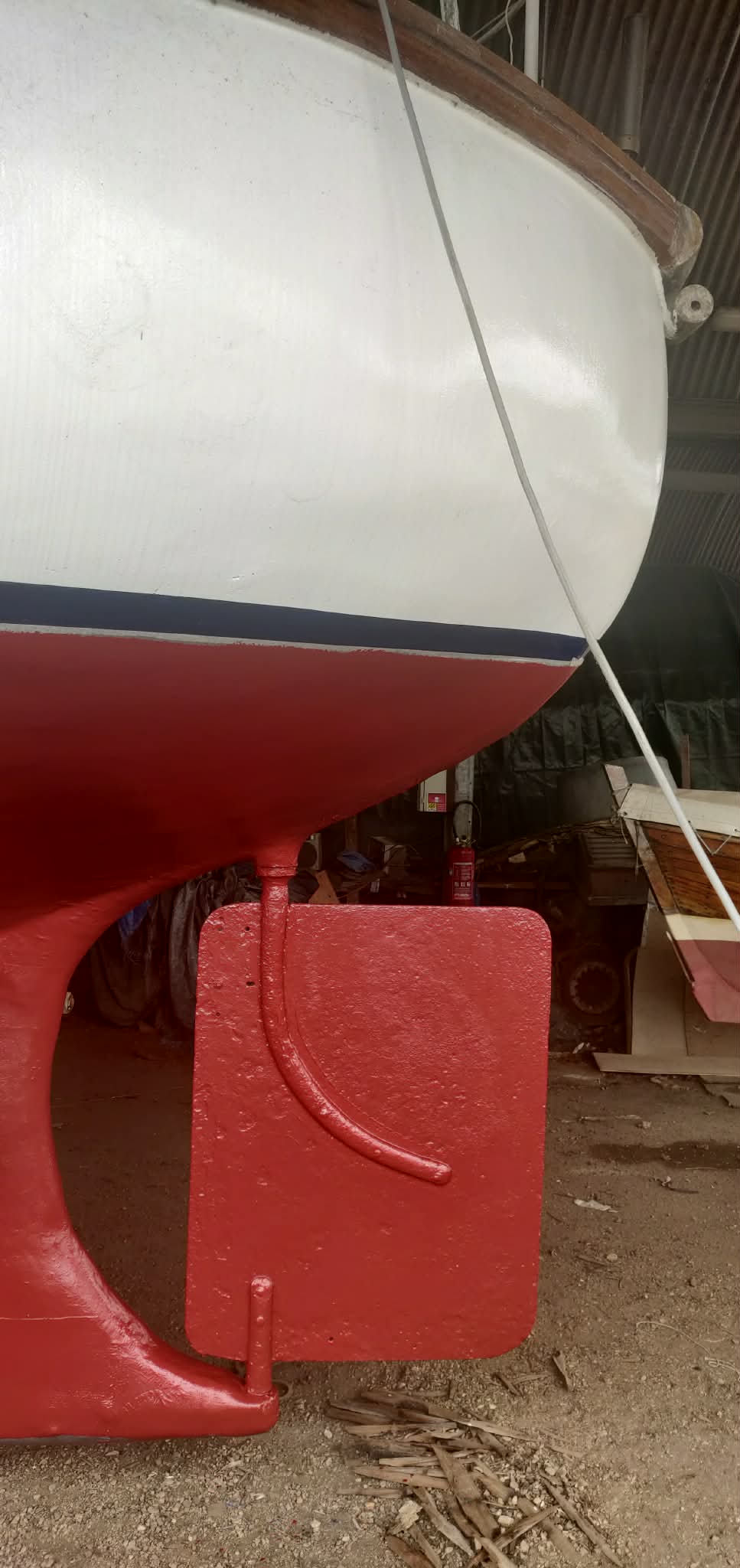
The Davia's red hull and rudder in dry dock during the major refit
The Davia in dry dock at the Evans boatyard, Migennes — a 24-month major refit

Towards the centenary

Towards 2029

Course set for the Davia's 100 years

The association's horizon has a name: 2029. That year, the Davia will celebrate her 100th birthday, the major narrative milestone around which the association is building its centenary project. The boat is also part of the Dunkirk Little Ships community, whose great gatherings keep alive the memory of Operation Dynamo.

Until then, the work continues: finishing the restoration of the deck, returning to the original teak, fitting the 21 ft (6.50 m) signal mast, resuming memorial voyages, organising public visits at Villeneuve-sur-Yonne, and preparing joint commemorations with the British associations.

It is this living, demanding, ongoing project that donations support. Every gift funds a concrete stage of the restoration and the preparation of the centenary.

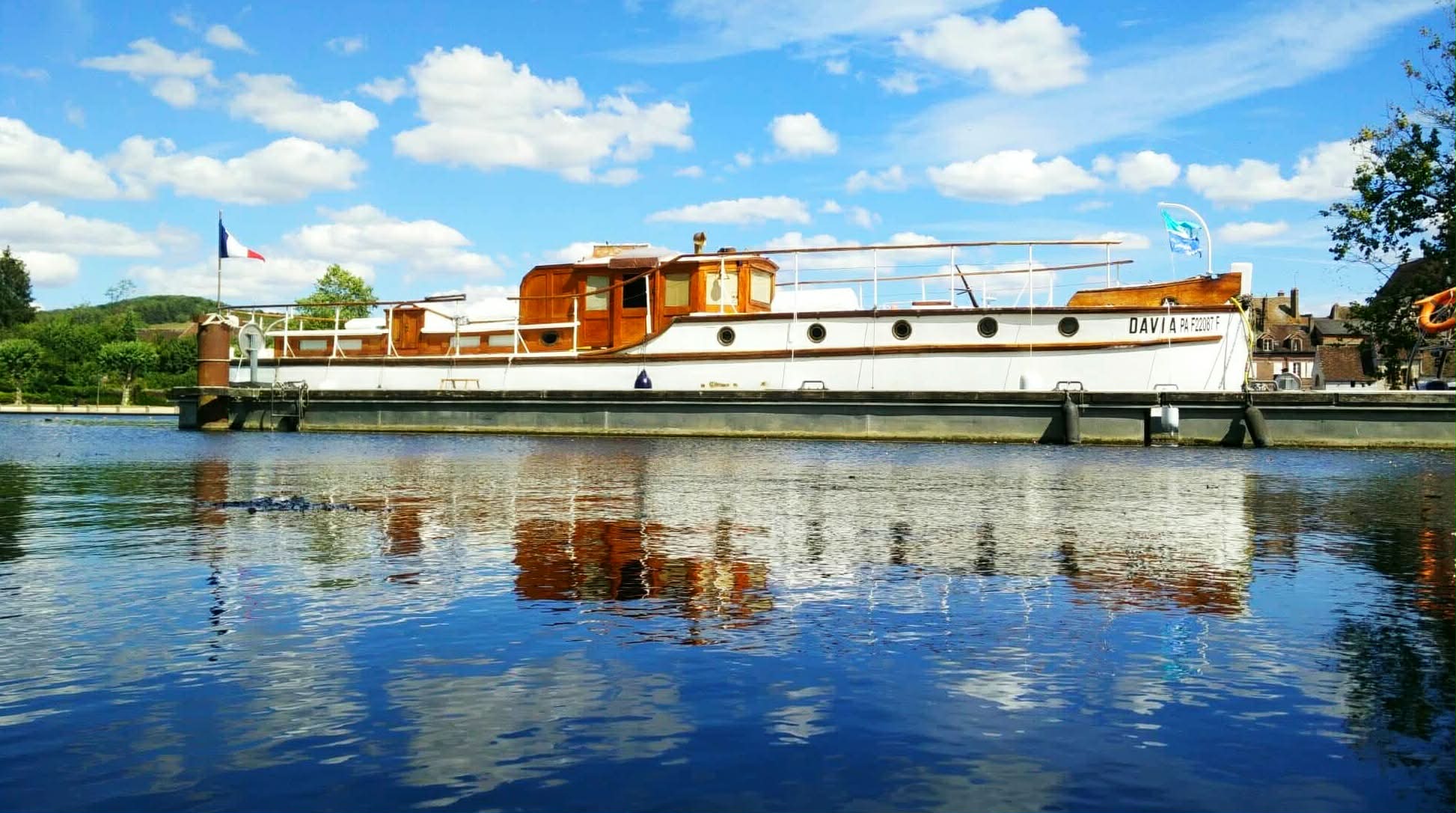
The Davia moored at the Villeneuve-sur-Yonne pontoon, blue sky
The Davia, moored in the harbour of Villeneuve-sur-Yonne — her permanent home port

« To make a donation for the preservation of naval heritage goes beyond a simple financial contribution. It is an act charged with emotion, a deep connection with our history. »

Bruno Van Hemelryck

Appeal for donations, Davia Association

So she can celebrate her 100 years in 2029

Visit the boat, support the restoration, or simply write to us — every gesture counts towards the centenary.

Read the ship's log

I support the Davia →